








The IRS Fresh Start Program is real. It’s also not a single program you enroll in. That confusion is worth clearing up immediately, because scammers exploit it constantly.
“Fresh Start” is the label the IRS gave to a set of policy changes it rolled out in 2011 and 2012 that expanded access to existing relief options: installment agreements, Offers in Compromise, tax lien relief, and penalty abatement. The underlying tools are legitimate IRS programs. The “Fresh Start” branding is mostly a marketing umbrella, which is why it shows up in so many predatory phone calls.
If you owe back taxes and you’re trying to figure out your options, this page covers what the IRS Fresh Start Program actually includes, who qualifies for each part, and how to apply.
Key Takeaways
- Fresh Start isn’t one program. It’s 2011-2012 policy changes that made installment agreements, Offers in Compromise, lien relief, and penalty abatement easier to access. All of it is still in effect in 2026.
- There’s no enrollment fee and no application form for “Fresh Start” itself. You apply directly to the specific relief option that fits your case.
- Streamlined installment agreements cover balances up to $50,000, no full financial disclosure required.
- OIC acceptance isn’t guaranteed and swings year to year, the IRS accepted 42.1% of offers in 2023 and 21.4% in 2024.
- Unfiled returns block every option. Filing compliance comes first, no exceptions.
Is the IRS Fresh Start Program Legitimate?
Yes. The IRS has used the term “Fresh Start” in its own official communications since 2011, across multiple releases, not just once: IR-2011-20 (February 2011, launching the initiative), IR-2012-31 (March 2012, adding penalty relief for the unemployed and self-employed), and IR-2012-53 (May 2012, revising Offer in Compromise terms specifically “to help a greater number of struggling taxpayers make a fresh start”). Read the current IRS.gov page on the initiative here.
The relief options it covers (payment plans, Offers in Compromise, penalty abatement, lien withdrawal) are real IRS programs with real applications and real outcomes. None of that changed in 2026.
What isn’t real: companies claiming you’re “pre-approved” for the Fresh Start Program without reviewing your financial situation. Or unsolicited calls saying the IRS will waive everything if you pay a processing fee today.
The IRS contacts taxpayers by mail first. After sending a notice, IRS employees or authorized private collection agencies may follow up by phone. The IRS won’t make initial contact by text, email, or social media, and will never demand payment by gift card or wire transfer over the phone.
There is no government enrollment fee for the IRS Fresh Start Program. Any company charging you a fee to “enroll” you in Fresh Start is running a scam. The IRS does not use third parties to enroll taxpayers in relief programs.
Common scam signals to watch for:
- Unsolicited contact by phone, text, or email claiming you qualify
- A “guaranteed” settlement before anyone has reviewed your finances
- Pressure to sign or pay immediately
- Requests for payment by gift card, wire transfer, or cryptocurrency
- Claims that arrest is imminent over unpaid taxes
For a longer list of red flags, see Precision Tax’s guide on tax debt scams.
What Is the IRS Fresh Start Program?
The IRS Fresh Start Initiative is a collection of policy changes rolled out in 2011 and 2012 that made existing IRS relief programs easier to access. Three changes defined it: the streamlined installment agreement threshold doubled from $25,000 to $50,000; the OIC income multiplier was cut from 48 months to 12 months for lump-sum offers (paid in 5 or fewer payments within 5 months), and from 60 months to 24 months for deferred offers (paid over 6 to 24 months); and the federal tax lien filing threshold rose from $5,000 to $10,000.
| Relief Area | Before Fresh Start | After Fresh Start (2011-2012) |
|---|---|---|
| Streamlined installment agreement | Up to $25,000 | Up to $50,000 |
| OIC income multiplier (lump-sum, 5 months or fewer) | 48 months | 12 months |
| OIC income multiplier (deferred, 6-24 months) | 60 months | 24 months |
| Federal tax lien filing threshold | $5,000 | $10,000 |
There is no Fresh Start application form. You apply to the specific relief option that fits your situation. The Fresh Start policy changes apply automatically when you do.
All Fresh Start provisions are permanent IRS policy, not a temporary program with an expiration date. Everything below still applies in 2026.
What Relief Options Does the IRS Fresh Start Program Include?
Streamlined installment agreements
Before Fresh Start, streamlined installment agreements were available only for balances up to $25,000. Fresh Start doubled the threshold to $50,000 in combined tax, penalties, and interest.
Taxpayers who qualify can set up a payment plan online without submitting a full financial disclosure form. Repayment can stretch up to 72 months. For balances between $25,001 and $50,000, direct debit is required. For details on minimum monthly payments, see Precision Tax’s guide on IRS installment agreements. You can apply through the IRS Online Payment Agreement tool.
Offer in Compromise
An Offer in Compromise lets eligible taxpayers settle their tax debt for less than the full amount owed. The IRS reviews your income, allowable living expenses, and asset equity to calculate your Reasonable Collection Potential (RCP): what it estimates it could realistically collect from you.
Fresh Start revised the income multiplier used in that calculation, cutting it from 48 months to 12 months for offers paid in 5 or fewer payments within 5 months, and from 60 months to 24 months for offers paid over 6 to 24 months. That change reduced the minimum acceptable offer amount significantly for many taxpayers with limited long-term earning potential.
The OIC application fee is $205, confirmed current for 2026 against the IRS Form 656 booklet. It’s waived for taxpayers who meet IRS low-income certification guidelines. You can’t be in active bunkruptcy when you apply. There’s no hard dollar ceiling on who can apply, eligibility is based on your RCP calculation.
Tax lien withdrawal
A tax lien is the IRS’s legal claim against your property. A levy is the actual seizure, the IRS can use it to take wages, bank accounts, or other assets. See Precision Tax’s guide on IRS tax levy powers for more on what the IRS can seize. They’re different actions with different consequences.
Before Fresh Start, the IRS filed a Notice of Federal Tax Lien automatically when a balance exceeded $5,000. That threshold rose to $10,000. Fresh Start also introduced lien withdrawal (separate from a standard release) for taxpayers who enter a Direct Debit Installment Agreement with a balance at or below $25,000. A withdrawal removes the public lien record entirely. A release only marks it as satisfied.
To request a withdrawal, submit Form 12277. See Precision Tax’s guide on federal tax liens for the full process, or the guide on requesting a lien withdrawal specifically.
Penalty abatement
Penalty abatement removes IRS penalties. It doesn’t remove the underlying tax or interest (interest tied to a successfully abated penalty can sometimes be removed, but that’s a separate request).
First-Time Abatement (FTA) applies if you filed all required returns, had no penalties assessed in the prior 3 tax years, and have paid or arranged to pay any balance due. In 2026, the IRS began applying FTA automatically for qualifying 2025 returns. For older penalty years, you can still request it by phone using the number on your IRS notice.
Reasonable Cause relief requires documented circumstances: serious illness, death in the family, natural disaster, or similar events that prevented timely compliance. See Precision Tax’s penalty abatement page for the documentation requirements.
Who Qualifies for the IRS Fresh Start Program?
Which Fresh Start Option Fits You?
A quick self-check before the full criteria below:
- Owe $50,000 or less and can pay it off within 6 years? Streamlined installment agreement, apply online in under 30 minutes.
- Income and assets fall short of covering the full balance? Offer in Compromise.
- Balance is $25,000 or less and you’re on a Direct Debit Installment Agreement? Lien withdrawal, Form 12277.
- Filed on time for the past 3 years with a clean penalty history? First-Time Abatement.
- None of these fit, and paying anything creates real hardship? Currently Not Collectible status.
Two baseline requirements apply across all options: all required federal tax returns must be filed, and you must stay current going forward. No option moves forward with unfiled years outstanding.
Beyond that, eligibility depends on which option you’re pursuing:
Streamlined installment agreement: owe $50,000 or less in combined tax, penalties, and interest; can pay the balance within 72 months or before the Collection Statute Expiration Date (CSED), whichever is shorter (see Precision Tax’s guide on understanding your CSED if you’re not sure how much time is left on yours). Direct debit required for balances over $25,000.
Offer in Compromise: no hard dollar ceiling. Must be current on all filing obligations and not in active bankruptcy. Eligibility is based on your RCP: what the IRS calculates it could collect from your income and assets.
Tax lien withdrawal: owe $25,000 or less (or have paid down to $25,000); active Direct Debit Installment Agreement with at least 3 consecutive payments made; full filing and payment compliance.
Penalty abatement (FTA): all required returns filed; no penalties assessed in the prior 3 tax years; balance paid in full or in an active payment arrangement.
Currently Not Collectible (CNC) status isn’t a Fresh Start provision specifically, but it’s a related option worth knowing. It applies when your income, after IRS-allowed living expenses, leaves nothing available for tax payments. Collections pause; the debt and interest continue to accrue. See Precision Tax’s guide on IRS hardship status.
How Do You Apply for IRS Fresh Start Relief?
You apply to the specific option that fits your situation, not to “Fresh Start” as a single program. The steps below apply across options.
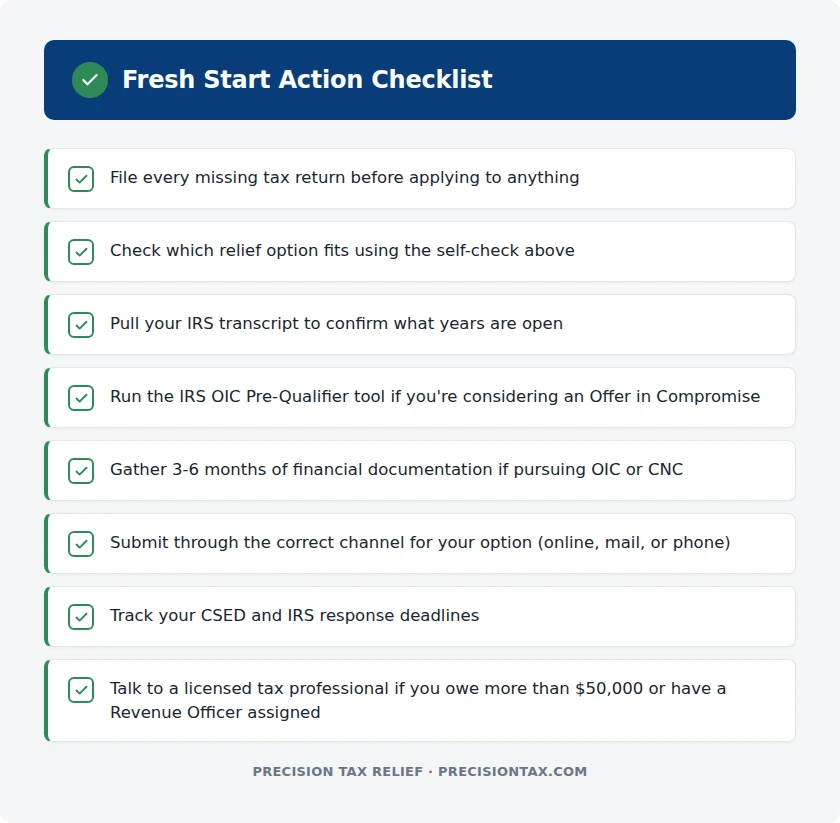
Step 1: File all missing returns. Nothing moves forward until you’re current on filings. If you haven’t filed in multiple years, that’s the starting point. Unfiled returns also carry their own penalties separate from what you owe, see Precision Tax’s guide on penalties for unfiled tax returns. You can review what years may be open through your IRS transcript.
Step 2: Identify the right path. Use the IRS OIC Pre-Qualifier tool to get a rough estimate on OIC eligibility. For installment agreements, if you owe $50,000 or less and can pay over 72 months, you can apply online in under 30 minutes without a financial disclosure.
Step 3: Gather documentation. Streamlined installment agreements under $50,000 require minimal paperwork. OIC and CNC require 3 to 6 months of bank statements, pay stubs, housing and utility costs, loan statements, and asset documentation using Form 433-A (individuals) or 433-B (businesses).
Step 4: Submit.
- Installment agreements under $50,000: apply online through the IRS Online Payment Agreement tool
- OIC: mail Form 656 + 433-A or 433-B + $205 fee + initial payment
- Lien withdrawal: Form 12277 by mail
- Penalty abatement (FTA): by phone using the number on your IRS notice, or in writing using Form 843
What Happens After You Apply?
Timelines vary by option. Streamlined installment agreements are typically approved the same day you apply online. OIC review takes 6 to 12 months on average, the IRS is required to make a determination within 2 years of receiving your application, and an offer is automatically accepted if no decision is issued within that window.
If your OIC is rejected, you have 30 days to appeal using Form 13711. See Precision Tax’s guide on what to do if your OIC was rejected for the appeal process in detail. An appeal goes to the IRS Office of Appeals, which reviews the case independently. Corrected or updated documentation can be submitted at that point.
If you don’t qualify for any current option, a short-term payment plan (up to 180 days, no setup fee) can buy time while your situation changes. There’s no penalty for requesting one.
When Does It Make Sense to Work with a Tax Professional?
A streamlined installment agreement for a balance under $50,000 is something most people can handle directly. The IRS online tool walks you through it in under 30 minutes.
OIC is more complicated. The RCP calculation has dozens of variables, and small differences in how you document allowable expenses can move the acceptable offer amount by tens of thousands of dollars. An incorrectly prepared OIC package also gets rejected outright, resetting your timeline. If you’re weighing whether to handle this yourself, see Precision Tax’s guide on DIY vs. hiring a tax professional.
Professional help makes sense when:
- You owe more than $50,000
- You have unfiled returns across multiple years
- You’re considering an OIC and your financial picture is complex
- A Revenue Officer has been assigned to your case
- A levy is active or imminent
What to look for in a tax relief company: licensed professionals only (CPAs, Enrolled Agents, or tax attorneys), no upfront fees before a financial review, a clear explanation of what your fee covers, and no guarantees about outcomes before they’ve seen your finances. See Precision Tax’s guide on 5 questions to ask before signing with a tax relief company for the full checklist.
Precision Tax Relief is ranked #1 Overall Best Tax Relief Company by Investopedia and is a three-time BBB Torch Award recipient (2019, 2023, and 2024). Every case is handled by a licensed tax professional, not a salesperson posing as an advisor. Free consultation, one business day response.