





Reasonable collection potential (RCP) is how the IRS measures what you can pay. It adds the value the IRS could realize from your assets to your future income after basic living expenses. In most cases, the IRS won’t accept an offer in compromise for less than your RCP (IRS Topic 204).
The living-expense standards cited here took effect June 29, 2026, and the asset figures come from the April 2026 revision of Form 656-B.
Key Takeaways
- RCP is the net realizable equity in your assets plus your remaining monthly income multiplied by 12 (lump sum offer) or 24 (periodic payment offer).
- Assets are valued at quick sale value, which is normally 80% of fair market value, minus loans that rank ahead of the IRS.
- Allowable expenses follow IRS standards, and if you share a home with someone who doesn’t owe the tax, you’re allowed only your share of the household costs.
- The months of income can’t exceed the time left on the collection deadline, and the IRS also checks what a payment plan would collect.
- An offer below RCP is usually rejected, though special circumstances can change the result.
What Is Reasonable Collection Potential?
The IRS describes RCP as the measure of your ability to pay. It includes what could be realized from your property, such as real estate, vehicles, and bank accounts, plus your anticipated future income less certain amounts allowed for basic living expenses (IRS Topic 204).
It matters because of how the Internal Revenue Manual (IRM), the IRS’s own rulebook for its employees, treats offers. For an offer based on doubt that you can pay in full, the decision usually rests on whether the amount offered reflects your RCP (IRM 5.8.4.3).
RCP isn’t your balance, and it isn’t a percentage of it. Two people who owe the same amount can have very different RCPs, because the number comes from your assets and income, not from the debt.
The IRS builds it from the financial statement you file with the offer, Form 433-A (OIC) for individuals, and then checks it against bank statements, pay records, and its own research. This guide covers how the IRS arrives at the number. To choose an offer amount, fund it, and pay it, see our guide to how much to offer in compromise. For the eligibility rules, see how to qualify for an offer in compromise.
How Does the IRS Calculate RCP?
The formula is in the IRS offer booklet. You add your available equity in assets to your future remaining income:
RCP = net realizable equity in assets + (remaining monthly income × 12 or 24)
On the form, the equity comes from Box A (personal assets) and Box B (business assets, if you have any). Remaining monthly income is Box F, your household income minus your allowed expenses. Box G multiplies Box F by 12, and Box H multiplies it by 24. Your minimum offer is the asset total plus Box G or Box H (Form 656-B, Rev. 4-2026).
Which multiplier you use depends on how you pay:
| Offer type | How you pay | Months of income counted | Form box |
|---|---|---|---|
| Lump sum | 20% with the application, the rest in 5 or fewer payments within 5 months of acceptance | 12 | Box G |
| Periodic payment | First payment with the application, then monthly payments within 24 months of acceptance (6 or more installments) | 24 | Box H |
Source: IRS Topic 204 and Form 656-B (Rev. 4-2026).
This choice is the biggest lever in the formula. The booklet says paying over a shorter period results in a smaller minimum offer amount. A periodic offer counts twice as many months of your income, so the minimum is higher even though your finances haven’t changed. A lump sum offer costs less in total, but you need the cash within 5 months.
One caution from the same booklet. The 12 and 24 multipliers, and the bank and vehicle adjustments below, don’t apply if the IRS determines you can pay your tax debt in full within the legal period to collect.
How Does the IRS Value Your Assets?
For offers, the IRS values assets at net realizable equity. That’s the quick sale value (QSV) minus what you owe to lenders with priority over the federal tax lien, minus any applicable exemption amounts (IRM 5.8.5.4.1).
QSV is the IRS’s estimate of what a seller could get if financial pressure forced a sale within about 90 days. The IRM says it’s normally 80% of fair market value. A higher or lower percentage can be used, and in a fast real estate market it can equal full market value.
Here’s how the main asset types appear on Form 433-A (OIC), using the April 2026 booklet:
| Asset | How it’s valued | Form line |
|---|---|---|
| Cash and bank accounts | Total balance minus $1,000 (individuals) | 1 |
| Stocks, bonds, digital assets | Current market value minus loan balance | 2 |
| Retirement accounts | Market value × 0.8 minus loans; the form notes the reduction can be larger because of taxes and early withdrawal penalties | 3 |
| Life insurance with cash value | Cash value minus policy loans | 4 |
| Real estate | Market value × 0.8 minus mortgage and other loans | 5 |
| Vehicles | Market value × 0.8 minus loan, then minus $3,450 per vehicle (one if single, two if joint) | 6 |
| Other valuables, furniture, personal effects | Market value × 0.8 minus loans, then a $11,980 deduction on the total | 7 |
Source: Form 656-B (Rev. 4-2026), Form 433-A (OIC) Section 3.
Three points the table doesn’t show:
- The adjustments are conditional: The $1,000, the $3,450, and similar exclusions apply only if you’re an individual and only after the IRS decides you can’t pay in full from equity, an installment agreement, or both (Form 656-B).
- Being unable to borrow doesn’t zero out an asset: The IRM says not to remove an asset because you can’t borrow against it or because the IRS chooses not to act on it (IRM 5.8.5.4). That’s one reason a home with equity still counts.
- Retirement money counts: For someone who isn’t retired or close to it, the IRM values an IRA or 401(k) at its cash value less the tax and early-withdrawal penalty. Voluntary retirement contributions aren’t treated as a necessary expense (IRM 5.8.5.10).
For real estate, the IRS compares several sources, such as online databases, the tax assessment, comparable sales, and recent purchase price, rather than relying on one (IRM 5.8.5.13). If the IRS values something higher than you listed, you’re supposed to get a chance to explain.
Which Living Expenses Does the IRS Allow?
Remaining monthly income is your gross household income minus allowable expenses. On the form, income goes in Box D (lines 30 to 38), and expenses go in Box E (lines 39 to 51). Box E subtracted from Box D gives Box F (Form 656-B).
Allowable expenses are the ones that meet the necessary expense test: needed for your family’s health and welfare or to produce income. The IRS measures most of them against its Collection Financial Standards (IRS Collection Financial Standards).
National Standards cover food, housekeeping supplies, clothing, personal care, and miscellaneous items. You get the total for your household size without the IRS questioning what you actually spend (IRS National Standards). The amounts effective June 29, 2026:
| Household size | Monthly total |
|---|---|
| 1 person | $867 |
| 2 people | $1,558 |
| 3 people | $1,857 |
| 4 people | $2,176 |
| Each additional person | add $397 |
Source: IRS National Standards, food, clothing and other items, effective June 29, 2026.
Out-of-pocket health care is a separate standard: $90 a month per person under 65 and $163 for people 65 and older, on top of what you pay for health insurance premiums (IRS health care standards).
Local Standards cover housing and utilities and transportation, and they vary by location. In most cases you’re allowed the amount you actually spend or the local standard, whichever is less.
Two form details trip people up. For line 39 (food, clothing, and miscellaneous) and line 45 (out-of-pocket health care), the booklet tells you to list the full standard even if you spend less. For the other lines, you list what you actually pay.
If a standard is too low to cover your basic living expenses, you can ask for more, but you need documentation. The tax regulations say the IRS will let you keep enough to pay basic living expenses, guided by the national and local standards (26 CFR 301.7122-1).
This is where many do-it-yourself offers go wrong. A minimum credit card payment doesn’t get its own line. The form folds it into line 39, and the miscellaneous part of the National Standard is meant to cover it. Discretionary investments, such as payroll savings plans, mutual funds, and voluntary retirement contributions, aren’t allowed either. And the extra allowances that apply to some installment agreements, called conditional expenses, don’t apply to offers (IRM 5.8.5.23).
How Does the IRS Split Household Income When Someone Else Doesn’t Owe the Tax?
If you share a home with someone who isn’t liable for the tax, such as a spouse who isn’t responsible for your tax debt, the IRS generally leaves that person’s income and assets out of your RCP (IRM 5.8.5.24). But it still asks about their income, because it needs to know how much of the shared household bills you actually pay.
That’s why Form 433-A (OIC) asks for income information from anyone else who contributes to your household, and it names a non-liable spouse as an example (Form 433-A (OIC), Rev. 4-2026).
IRM 5.8.5.24 sets out the method the IRS uses:
- Add up the total household income.
- Work out what percentage of that income is yours.
- Identify the expenses you and the other person have agreed to share, such as bills paid from a joint checking account. An expense with no sharing agreement, such as child support or union dues, isn’t treated as shared.
- Apply your percentage to the shared expenses, and check that you actually contribute at least that much.
Your percentage is then applied to the standard amounts for the whole household, with a floor and a cap:
- Food, clothing, and other items, plus out-of-pocket health care: if your share comes out below the one-person standard, you’re allowed the one-person standard.
- Housing, utilities, and transportation: you’re allowed your calculated share or the standard, whichever is less.
- Expenses only you pay: costs such as alimony or child care are considered separately.
- The other person’s discretionary spending: nothing you pay toward it is allowed.
Here’s a hypothetical. You earn $4,000 a month, and your spouse, who doesn’t owe the tax, earns $6,000. You bring in 40% of the household’s $10,000. The two-person National Standard is $1,558, and 40% of that is about $623. That’s below the one-person standard of $867, so you’re allowed $867.
Leaving the other person’s income off the form usually backfires. If that income isn’t provided or can’t be verified, the IRS allows only the national and local standards for one person, plus any dependents it can verify (IRM 5.8.5.24). Lower allowed expenses mean a higher RCP.
Two situations follow different rules. In community property states (Arizona, California, Idaho, Louisiana, Nevada, New Mexico, Texas, Washington, and Wisconsin, with Alaska as an opt-in state), state law decides how much of a non-liable spouse’s income and assets the IRS can reach. And when spouses who owe a joint debt file separate offers, the IRS computes one RCP for the household and splits it between the offers, which together have to equal or exceed that total (IRM 5.8.5.24).
Not sure what your RCP looks like? Precision Tax Relief offers a free consultation with a licensed Enrolled Agent (EA), federally authorized to represent taxpayers before the IRS. You can also read about our offer in compromise help.
Example: Working Out an RCP Line by Line
This is a hypothetical example to show the arithmetic. It isn’t a prediction for your case. Assume a single filer under 65 in a one-person household who owes $85,000, including penalties and interest, with 8 years left on the collection deadline. Rent and car operating costs are assumed to be at or below the local standards.
Step 1: Assets (Box A).
| Line | Asset | Math | Amount |
|---|---|---|---|
| 1 | Checking and savings | $4,200 − $1,000 | $3,200 |
| 3 | 401(k) | $10,000 × 0.8 | $8,000 |
| 6 | Car, $18,000 value, $8,000 loan | ($18,000 × 0.8) − $8,000 = $6,400, then − $3,450 | $2,950 |
| 7 | Furniture and personal effects, $6,000 | $6,000 × 0.8 = $4,800, minus the $11,980 deduction (can’t go below $0) | $0 |
| Box A total | $14,150 |
Step 2: Monthly income and expenses (Boxes D, E, F).
| Line | Item | Amount |
|---|---|---|
| 30 | Gross monthly wages (Box D) | $4,600 |
| 39 | National Standard, 1 person | $867 |
| 40 | Rent and utilities | $1,500 |
| 41 | Car loan payment | $350 |
| 42 | Car operating costs | $300 |
| 44 | Health insurance premium | $200 |
| 45 | Out-of-pocket health care standard | $90 |
| 49 | Taxes withheld each month | $693 |
| Box E total | $4,000 | |
| Box F, remaining monthly income ($4,600 − $4,000) | $600 |
Step 3: Apply the multiplier.
- Lump sum offer: $14,150 + ($600 × 12 = $7,200) = $21,350
- Periodic payment offer: $14,150 + ($600 × 24 = $14,400) = $28,550
The same finances produce two minimums that are $7,200 apart, because the second offer counts 12 more months of income.
A rough screen shows why this person might be looking at an offer at all. Equity of $14,150 plus $600 a month for 96 months ($57,600) is $71,750, which is less than $85,000. The IRS runs its own full-pay test first, using installment agreement standards and without the $1,000 and $3,450 adjustments, so treat this as an estimate only (IRM 5.8.5.2).
How Does Your Collection Deadline Change the Number?
The IRS generally has 10 years from the date a tax is assessed to collect it (IRS, Time IRS can collect tax). That deadline is the Collection Statute Expiration Date (CSED), and each assessment has its own. Our page on how long the IRS can collect explains how it’s set.
The deadline can shrink your future income figure. The IRS projects income for 12 months on a lump sum offer or 24 months on a periodic offer, or for the time remaining on the collection period, whichever is less (IRM 5.8.4.3.1). An example in IRM 5.8.5.25 involves an offer covering one tax year with 10 months left on the collection deadline, so future income is counted for 10 months.
The same section says the cap applies when fewer months remain on every tax period in the offer. If another year in the same offer has much more time left, and you can’t pay in full over that longer period, the full 12 or 24 months is used.
Back to the example. If the only year in the offer had 10 months left, the lump sum and periodic figures would both be $14,150 + ($600 × 10 = $6,000) = $20,150. If it has 8 years left, the cap doesn’t apply, and the long runway creates a different issue.
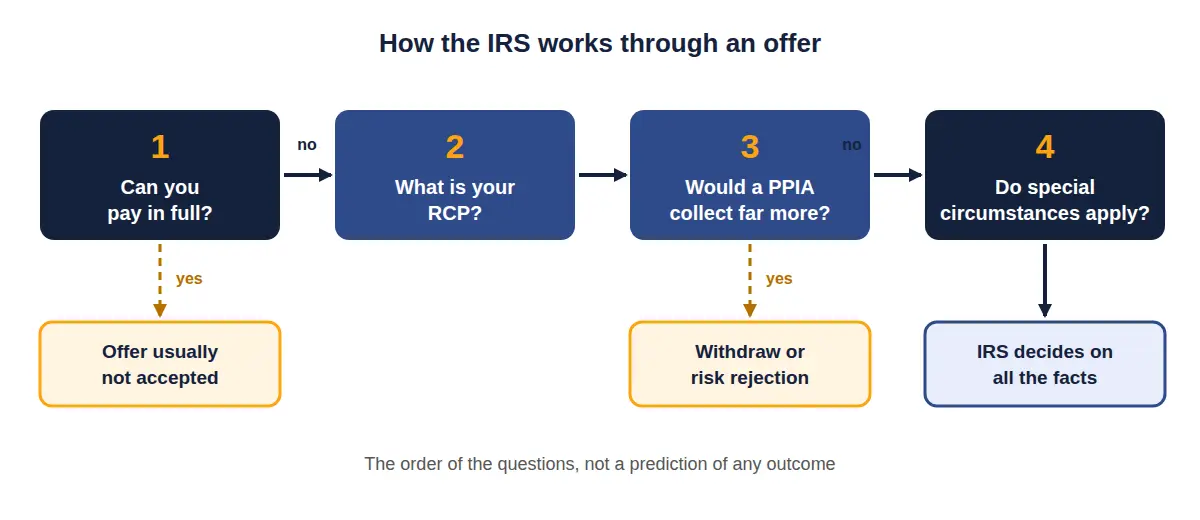
The IRS also compares RCP with what a partial payment installment agreement (PPIA) could collect. A PPIA is an installment agreement that won’t pay the full balance before the CSED (IRS Instructions for Form 9465). If the IRS expects to collect substantially more through a PPIA than your RCP, it may ask you to withdraw the offer and consider a PPIA, or it may reject the offer. It isn’t automatic, and the IRM doesn’t state a ratio.
In one IRM example, a taxpayer owed $50,000 and offered $15,000 while a PPIA could collect about $25,000, and the offer should be accepted. In another, a taxpayer owed $200,000 and offered $36,000, which matched an RCP built on $1,500 a month. With about 9 years left, a PPIA could bring in more than $162,000, and the offer should be rejected unless special circumstances applied (IRM 5.8.4.3).
In our example, $600 a month over 96 months is $57,600, far above $21,350. That gap is the kind the IRS weighs. For the options beyond an offer, see our guide to choosing an IRS payment plan and our page on tax debt expiration.
Can the IRS Accept an Offer Below RCP?
Sometimes, but not often. Topic 204 says the IRS won’t accept an offer below RCP “in most cases.” The regulations leave the final decision to the IRS and say it considers all the facts and circumstances, including whether a case warrants accepting an amount that might not otherwise be acceptable (26 CFR 301.7122-1).
The regulations handle special circumstances under effective tax administration, and they give two routes. One is economic hardship, where you could pay in full but doing so would leave you unable to meet basic living expenses. The other is exceptional public policy or equity considerations. Examples in the regulation include a long-term illness or disability, income used up caring for dependents, and equity that you can’t borrow against, where selling the asset would leave you unable to cover basic living costs.
If you can’t pay the amount the form calculates, the booklet says to put the amount you can pay on Form 656 (Section 4) and explain your special circumstances in Section 3.
If the IRS rejects the offer, the application fee isn’t returned, and payments are applied to your balance. You have 30 days from the date of the letter to appeal (IRS Offer in compromise page; Topic 204). Our guide on what to do after a rejected offer covers the next steps.
What If Your RCP Is More Than You Owe, or Close to It?
Then an offer is probably the wrong tool. The IRS says it generally won’t accept an offer if you can pay in full through a payment plan, equity in assets, or both (IRS Offer in compromise page).
- RCP at or above your balance: a payment plan or paying from equity is the likely path. Our IRS payment plan page covers the options.
- RCP far below your balance, but a long time left on the deadline: a PPIA may fit better, as the comparison above shows.
- No money left after allowed expenses, and little equity: the IRS may temporarily delay collection when you can’t pay because of financial hardship (IRS, Temporarily delay the collection process). Read more about Currently Not Collectible status and our IRS hardship status help.
What About Assets You Already Sold or Gave Away?
The IRS can add the value of a “dissipated” asset to your RCP. The IRM describes this as assets you sold, transferred, or spent on things other than necessary expenses or income production, after the tax was assessed or within about six months before or after the assessment. Generally, the IRS looks back three years from the offer. It isn’t automatic, and you can show that the money paid necessary living expenses (IRM 5.8.5.18; IRM 8.23.3).
If the IRS includes a dissipated asset and you won’t add it to your offer, it can reject the offer. Our article on dissipated assets in an offer in compromise explains it in detail.
How Precision Tax Relief Can Help
An RCP is only as good as the documents behind it. Missing an asset, overstating an expense, or getting the household split wrong can move the number by thousands of dollars. A licensed EA can run the calculation before you file, so you know whether an offer, a payment plan, or hardship status fits.
The consultation is free. Reach out below, or read more about our offer in compromise service.
This article gives general information about IRS collection procedures. It is not individualized tax or legal advice, and your situation may differ. Talk to a licensed professional about your own case.

